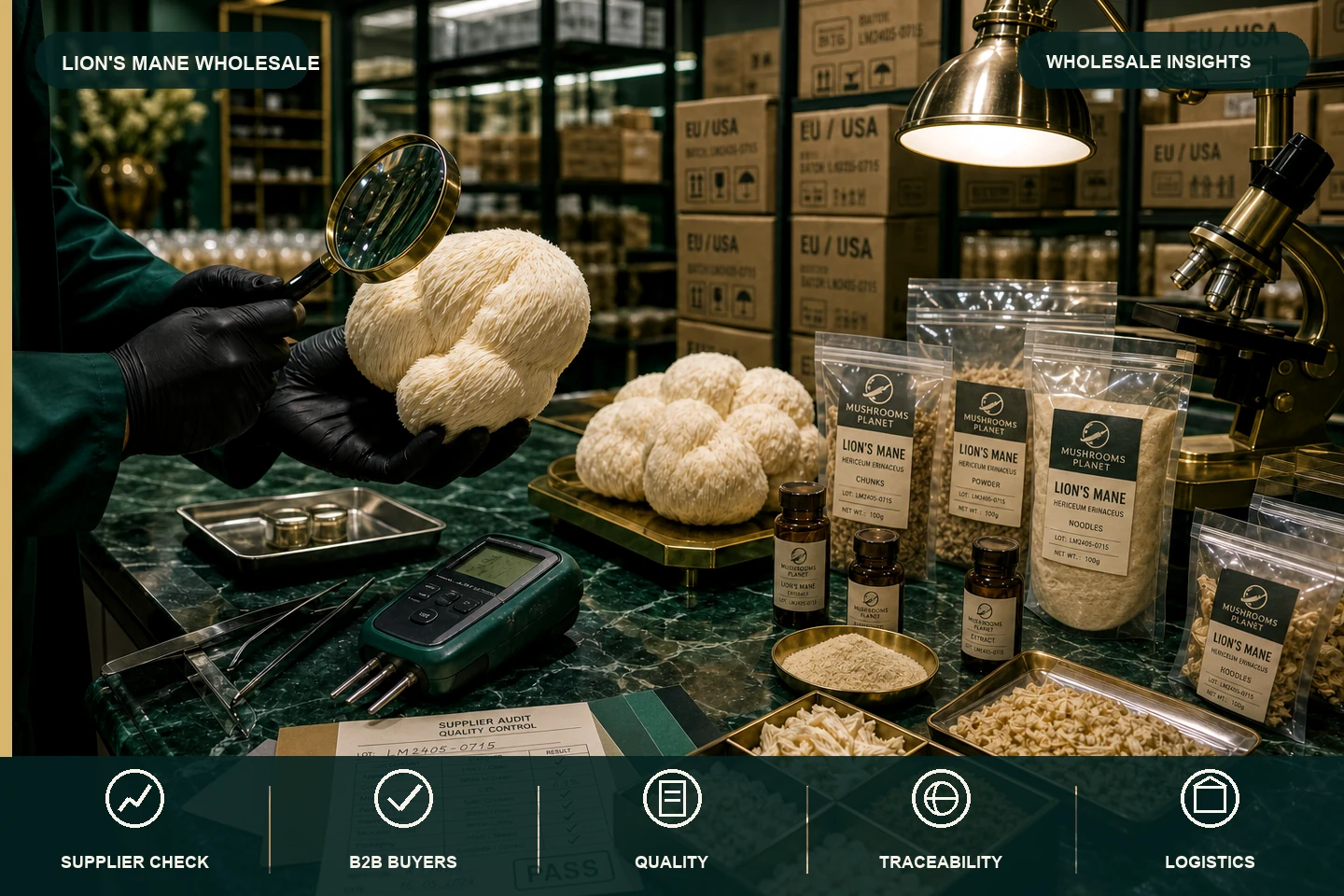
Professional Lion's Mane procurement starts with measuring supplier reliability beyond a single quotation. A clear commercial brief lets suppliers quote the correct product instead of offering an approximate match.
Purchasing and quality teams should record decisions about answer quality, evidence, packing, communication and repeat-order performance before approving price or volume.
Define the commercial requirement
State the destination, intended sales or production channel and the exact decision needed around answer quality, evidence, packing, communication and repeat-order performance.
Use one written brief for every supplier so offers can be compared on the same basis.
For Lion’s Mane, convert this decision into a dated written reference shared by purchasing, quality, warehouse and the supplier. Record the responsible reviewer, the evidence used and any permitted variation so the same control can be applied to the sample, production lot and repeat order.
Translate names into specifications
Product names are starting points, not complete standards. Record the characteristics that will be inspected at sample approval and receiving.
Where natural variation is expected, agree a realistic range rather than relying on an unstated visual expectation.
For Lion’s Mane, convert this decision into a dated written reference shared by purchasing, quality, warehouse and the supplier. Record the responsible reviewer, the evidence used and any permitted variation so the same control can be applied to the sample, production lot and repeat order.
Request relevant evidence
Current photographs, representative samples and available batch-linked records should correspond to the proposed format.
Keep the approved reference with the purchase file so warehouse and production teams can use it later.
For Lion’s Mane, convert this decision into a dated written reference shared by purchasing, quality, warehouse and the supplier. Record the responsible reviewer, the evidence used and any permitted variation so the same control can be applied to the sample, production lot and repeat order.
Test the operational process
A pilot order should test communication, documents, packing and delivery as well as the material itself.
Record deviations and corrective actions before moving to a larger or repeat order.
Review complete landed value
Compare minimum quantity, lead time, packaging, documentation and delivery responsibility together with unit price.
The most dependable offer is the one that meets the written requirement with the least avoidable rework and uncertainty.
Compare operational evidence, not promises
Supplier comparison should use the same request brief and evidence list for every candidate. Review whether quotations, specifications, samples, batch records and packing labels describe the same product, and distinguish verified capability from options that are only proposed.
Test corrective-action response
Ask how the supplier investigates a deviation, protects other lots and documents corrective action. A clear, timely response to a sample or pilot-order issue is stronger evidence of repeat-supply capability than a perfect marketing presentation with no defined escalation process.