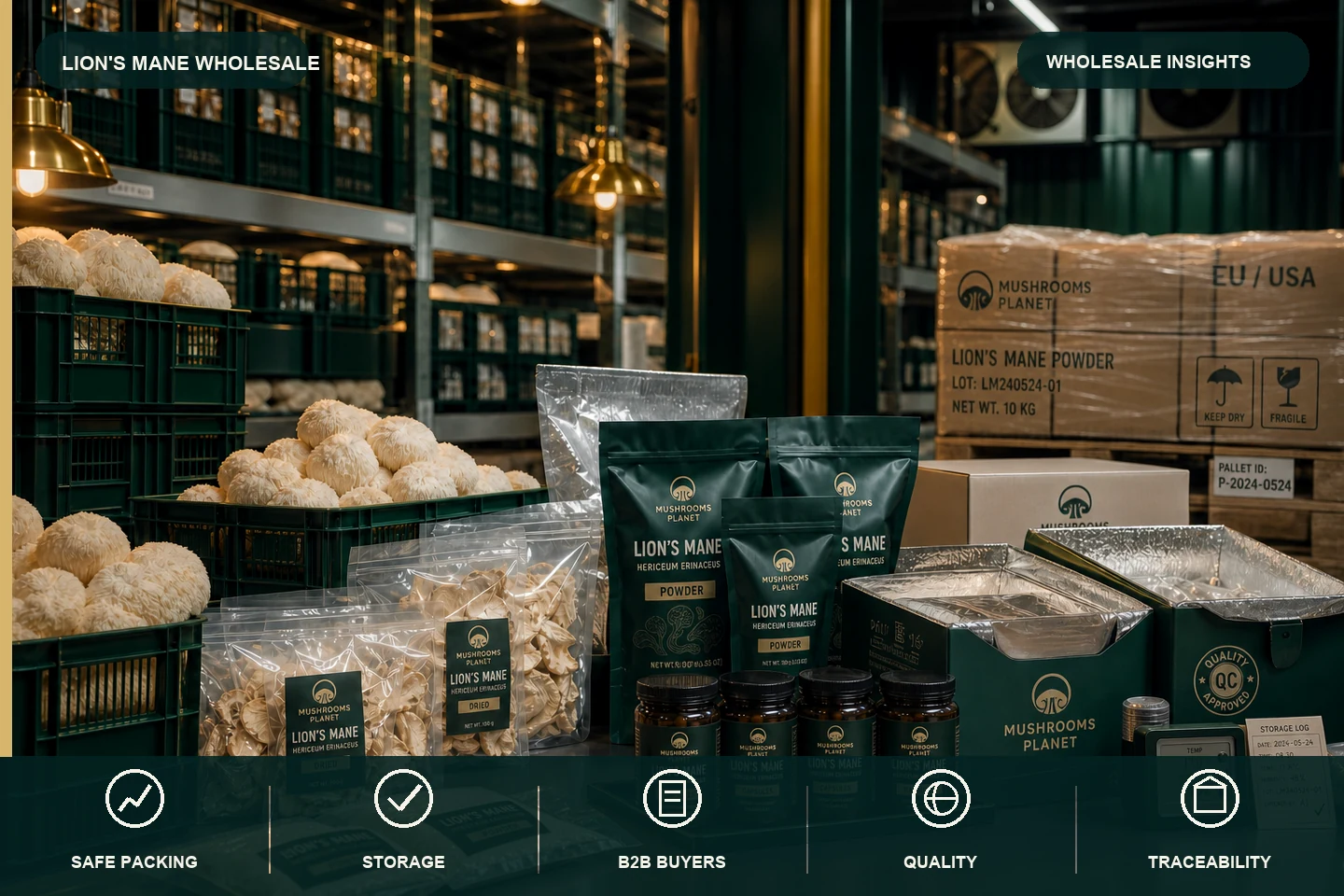
Professional Lion's Mane procurement starts with protecting whole mushrooms, powders and finished formats through transport and warehousing. A clear commercial brief lets suppliers quote the correct product instead of offering an approximate match.
Purchasing and quality teams should record decisions about inner packs, moisture control, physical protection and stock rotation before approving price or volume.
Define the commercial requirement
State the destination, intended sales or production channel and the exact decision needed around inner packs, moisture control, physical protection and stock rotation.
Use one written brief for every supplier so offers can be compared on the same basis.
For Lion’s Mane, convert this decision into a dated written reference shared by purchasing, quality, warehouse and the supplier. Record the responsible reviewer, the evidence used and any permitted variation so the same control can be applied to the sample, production lot and repeat order.
Translate names into specifications
Product names are starting points, not complete standards. Record the characteristics that will be inspected at sample approval and receiving.
Where natural variation is expected, agree a realistic range rather than relying on an unstated visual expectation.
For Lion’s Mane, convert this decision into a dated written reference shared by purchasing, quality, warehouse and the supplier. Record the responsible reviewer, the evidence used and any permitted variation so the same control can be applied to the sample, production lot and repeat order.
Request relevant evidence
Current photographs, representative samples and available batch-linked records should correspond to the proposed format.
Keep the approved reference with the purchase file so warehouse and production teams can use it later.
For Lion’s Mane, convert this decision into a dated written reference shared by purchasing, quality, warehouse and the supplier. Record the responsible reviewer, the evidence used and any permitted variation so the same control can be applied to the sample, production lot and repeat order.
Test the operational process
A pilot order should test communication, documents, packing and delivery as well as the material itself.
Record deviations and corrective actions before moving to a larger or repeat order.
Review complete landed value
Compare minimum quantity, lead time, packaging, documentation and delivery responsibility together with unit price.
The most dependable offer is the one that meets the written requirement with the least avoidable rework and uncertainty.
Design receiving and segregation controls
Receiving should check carton condition, quantities, lot labels and agreed product attributes before stock is mixed with an existing lot. Assign a clear quarantine or review location for discrepancies and keep different species, grades or formats physically and digitally distinguishable.
Protect traceability through release
Warehouse records should preserve the link from outer carton to inner pack and customer release. Use lot-based locations, controlled relabelling and first-expiry or agreed rotation rules, then investigate any damaged seal, moisture concern or identifier mismatch before dispatch.